Did you know that proper thermal insulation can reduce heating and cooling costs by up to 50%? This striking statistic highlights why choosing the right thermal insulation materials has become crucial for modern construction and renovation projects. The Latest Results reveal surprising winners in this article, 7 Thermal Insulation Materials Compared.
Recent laboratory tests have revealed surprising differences in performance among various thermal insulation options. While traditional materials like fibreglass remain popular, newer alternatives show remarkable results in energy efficiency and cost-effectiveness. These findings challenge long-held assumptions about which insulation materials work best.
This comprehensive guide examines seven major thermal insulation types, from Aerolite and Knauf to Rockwool and spray foam. We’ll analyse their performance data, compare their specifications, and help you understand which solution best suits your needs.

Aerolite Thermal Insulation
Aerolite thermal insulation, manufactured using TEL Fiberising technology, is notable for its exceptional heat transfer resistance and bio-soluble composition. Laboratory tests confirm that this material reduces heat penetration by up to 87%.
Benefits of Aerolite Thermal Insulation
The advanced glasswool composition delivers remarkable temperature control, maintaining indoor spaces 4-8 degrees cooler in summer and warmer in winter. Buildings typically lose up to 40% of their energy through poor insulation. However, Aerolite’s thermal resistance effectively reduces energy consumption by up to 35%.
Furthermore, this thermal insulation material demonstrates impressive durability, functioning effectively for 30-50 years without maintenance. Made from 80% recycled glass, Aerolite proves environmentally responsible, conserving 100 times more energy than required for its manufacture, transport, and disposal.
Acoustic and Sound Proofing
In terms of acoustic performance, Aerolite achieves a Noise Reduction Coefficient (NRC) of 1.1, establishing superior sound absorption capabilities. The material’s advanced sound absorption mechanism converts sound waves into heat energy through friction, notably reducing airborne and impact noise transmission.
Specifications
The technical specifications underscore Aerolite’s performance capabilities:
- Thermal conductivity (K-value): 0.040 W/mK
- Fire rating: Non-combustible (SANS 10177 Part 5)
- Density: 12kg/m³
- R-value: 3.38 (installed R-value: 3.78)
Additionally, Aerolite is available in various thicknesses:
- 50mm: R-value 1.25
- 100mm: R-value 2.5
- 135mm: R-value 3.38
The material exhibits non-hygroscopic properties and remains fully compatible with standard building materials, preventing steel, copper, or aluminium corrosion.
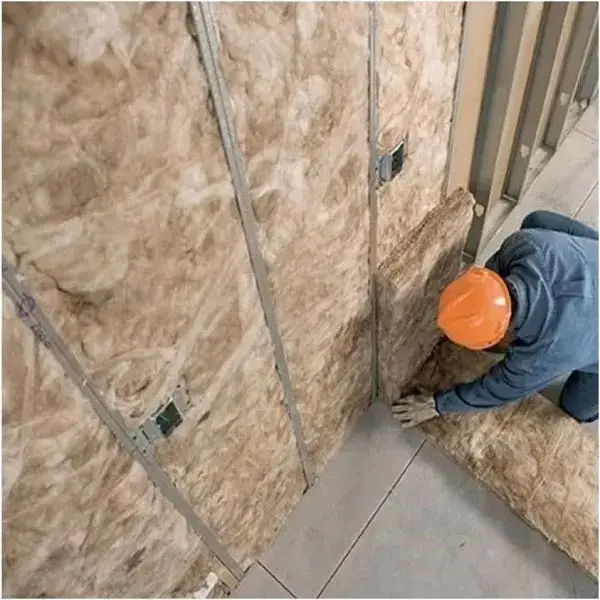
Knauf Thermal Insulation
Knauf Insulation’s mineral wool composition delivers exceptional thermal performance through its unique fibre matrix structure. Laboratory tests confirm its thermal conductivity at 0.040 W/mK, establishing it as a leading thermal insulation solution.
Knauf Insulation Benefits
The material’s effectiveness stems from its ability to reduce heat flow through three distinct mechanisms: conduction, convection, and radiation. Its 110.4 kg/m³ density, the glass mineral wool structure creates small voids that minimise air movement. Initially, this composition helps maintain stable indoor temperatures, reducing energy consumption in heating and cooling scenarios.
Specifically, the material demonstrates superior buildability characteristics. The mineral wool strands knit together when individual rolls or slabs are joined, eliminating air gaps. This feature ensures consistent thermal performance throughout the installation’s lifetime, unlike rigid foam boards that may experience performance degradation over time.
Acoustics and soundproofing
The acoustic performance of Knauf insulation stands out, particularly in noise reduction applications. This sound-absorbing material within cavity walls improves the overall sound insulation rating by up to 10 dB compared with empty cavities. Primarily, the fibre matrix encourages sound wave absorption, converting them into heat energy.
The material’s effectiveness extends across various frequencies, making it suitable for airborne and impact noise reduction. Testing demonstrates that Knauf’s acoustic performance surpasses polyester insulation of the same thickness in a typical steel stud system with a 12.5mm plasterboard on both sides.
Specifications
The technical specifications underscore Knauf’s performance capabilities:
- Fire rating: Euroclass A1 (non-combustible)
- Noise Reduction Coefficient: 1.13 for 135mm thickness
- Roll dimensions: 1.2m width with Combi-Cut (800+400)
- Available thicknesses:
- 135mm: R-value 3.38 (installed R-value 3.78)
- 100mm: R-value 2.50 (installed R-value 2.90)
- 50mm: R-value 1.25 (installed R-value 1.65)
The material exhibits non-hygroscopic properties, preventing moisture absorption from the air and effectively resisting mould and mildew growth.

Isotherm Polyester Thermal Insulation
First and foremost, Isotherm thermal insulation stands out for its innovative composition of 100% thermally-bonded polyester fibres produced from recycled PET bottles. This eco-conscious material demonstrates remarkable versatility in roof, wall, and geyser insulation applications.
Benefits of Isotherm Polyester Insulation
The material’s distinctive advantages stem from its non-allergenic and non-irritant properties. Indeed, its soft texture facilitates straightforward installation without requiring protective gear. The insulation effectively maintains indoor temperatures, reducing cooling requirements by up to 7°C in summer 11 and decreasing heating energy needs by 40-70% in winter.
Moreover, Isotherm’s moisture resistance is noteworthy. It absorbs no more than 2% moisture by mass. This characteristic and its resistance to condensation prevent the growth of fungi and bacteria. The material’s resilient nature retains its loft and structural integrity over time.
Specifications
The technical profile of Isotherm insulation encompasses several crucial parameters:
- Fire Performance: Achieves B/B 1/2 classification under SANS 428 testing
- Thermal Properties: Delivers R-values ranging from 2.7 to 3.7(m².K/W) for roofs and ceilings
- Wall Installation: Maintains R-values between 1.9 and 2.2, depending on climate zone
- Durability: Functions effectively for 30 years
- Density Options: Available in 11.5kg/m³ for optimal thermal performance
Subsequently, the material’s high melting point contributes to its excellent thermal stability. The insulation’s bonded blanket construction maintains a consistent thickness despite external factors such as wind or ceiling movement.

Isoboard Thermal Ceilings
Since 1995, Isoboard thermal ceilings have been manufactured. They represent a significant advancement in insulation technology, featuring a high-density extruded polystyrene composition with a 100% closed-cell structure.
Isoboard Thermal Ceiling Benefits
The material’s closed-cell structure effectively blocks heat transfer, reducing heating energy requirements by 40% to 70% during winter. Accordingly, buildings equipped with Isoboard can achieve temperature reductions of up to 7°C compared to uninsulated spaces. The material functions effectively across temperature ranges from -30°C to +70°C.
Specifications
The technical parameters of Isoboard include:
- Thermal conductivity: 0.030 W/mk
- Standard board lengths: 4800mm to 8000mm (±5mm tolerance)
- Width: 600mm (±2mm tolerance)
- Thickness options: 25mm, 30mm, 40mm, and 50mm (±2mm tolerance)

Rockwool Applications
Analogous to its thermal properties, Isoboard demonstrates versatility across various applications. At length, the material proves effective in retail, commercial, industrial, and residential steel frame roof installations. Primarily, its application extends to inverted roofs, under-soffit installations, and over-rafter configurations.
Acoustics and Soundproofing
Isoboards should not be used in isolation for noise reduction. Specialists recommend combining them with dedicated sound reduction systems for optimal acoustic performance.
Specifications
The material exhibits remarkable durability, with water absorption limited to 1% by volume. Additionally, the compressive strength and density increase proportionally with board thickness. The material remains chemically inert, odourless, and resistant to microorganism growth. These properties make it particularly valuable in challenging environmental conditions, and it maintains its structural and insulative properties throughout its service life.
Rockwool Industrial Insulation
The ProRox range of stone wool insulation is at the forefront of industrial thermal protection. Laboratory tests confirm its ability to withstand temperatures above 1000°C. Primarily designed for the petrochemical, power generation, and refining industries, this advanced insulation solution effectively protects critical infrastructure.
Recent testing at BASF Antwerp’s facility, which houses 1,200km of pipes, revealed remarkable results for the ProRox WR-Tech pipe section. After three years of continuous use, the material achieved a water absorption rate of just 0.1kg/m², staying well within the European standard EN 13472 limit of <1kg/m². Fundamentally, this performance surpasses ROCKWOOL’s stringent standard of <0.2kg/m².
The material’s effectiveness extends beyond mere water resistance. The fibrous structure of ProRox PS 960 pipe sections allows moisture to evaporate naturally, making it exceptionally suitable for applications experiencing temperature cycles between 120°C and 140°C. This characteristic proves invaluable in preventing corrosion under insulation (CUI), a critical concern in industrial settings.
The material’s versatility shines through its diverse applications. The ProRox range serves multiple industrial components:
- Storage tanks for process stability
- Columns in chemical plants
- Vessels for procedural processes
- Industrial boilers operating up to 300°C
- Chimneys requiring low thermal conductivity
The insulation’s effectiveness stems from its innovative fibre structure, which creates an impermeable barrier against heat transfer. This configuration regulates temperatures and protects against fire, noise, and corrosion. Installing these solutions has generally demonstrated significant energy savings, with recent implementations projected to save industrial customers up to €77 billion in lifetime energy costs.

Spray Foam
Modern spray foam thermal insulation combines advanced chemical technology with precise application methods to create an effective thermal barrier. Laboratory tests demonstrate that spray foam achieves an R-value of 6.4 per inch, surpassing traditional insulation materials.
Benefits of spray foam
Spray foam’s expanding nature primarily allows it to seal all gaps and crevices effectively, creating an airtight barrier that reduces air infiltration 24 times compared to other insulation types. This comprehensive sealing capability helps reduce energy costs by up to 50%.
The material’s closed-cell structure simultaneously acts as a moisture barrier, preventing water infiltration and mould growth. Rather uniquely, spray foam maintains its structural integrity and insulative properties even when exposed to water 4.
Spray foam fire rating.
The fire safety performance of spray foam meets rigorous Australian standards, tested under AS1530.3. Testing results reveal:
- Ignition Time: 4.28 minutes
- Heat Release Integral: 47.8 kJ/m²
- Smoke Release: Optical density 0.2582/metre
The material achieves a Group 2 classification, with regulatory indices including:
- Ignitability Index: 16 (Range 0-20)
- Spread of Flame Index: 0 (Range 0-10)
- Heat Evolved Index: 1 (Range 0-10)
- Smoke Developed Index: 5 (Range 0-10)
Specifications
The technical profile demonstrates presently available configurations:
- Thermal conductivity: Achieves 7.1 R-value per inch for closed-cell variants
- Density: 2.0±10% lbs/ft³
- Closed Cell Content: 97.8%
- Compressive Strength: 32.0 psi
- Water Vapour Permeance: 0.628 US perms at 2 inches thickness
The material requires professional installation in temperatures between 40 degrees F (4.4 degrees C) and 120 degrees F (49 degrees C), with relative humidity below 85%. Alternatively, the installation process can be customised to specific building requirements, ensuring optimal thermal performance across various applications.

Cellulose Insulation
Among thermal insulation materials, cellulose stands out for its exceptional composition of up to 85% recycled paper and cardboard. This eco-friendly material is also remarkable in its versatility in new construction and retrofitting applications.
Benefits of Cellulose
Above all, cellulose insulation achieves an R-value of 3.8 per inch, providing superior thermal resistance. In addition, adequately installed cellulose significantly reduces air infiltration, leading to potential savings of 15% on heating and cooling costs.
The material’s fire-resistant properties make it a Class I material, allowing its exposed installation in occupied spaces like basements. The borate treatment serves dual purposes: fire resistance and pest control. When installed correctly, the material has been functioning effectively for decades.
Under those circumstances where sound control matters, cellulose’s dense fibre structure creates an effective barrier against noise transmission. Together with its thermal properties, the material’s ability to block sound makes it particularly valuable for residential and commercial applications.
Cellulose Water Absorption with the roof
The material’s relationship with moisture requires careful consideration. Laboratory studies reveal that cellulose fibres demonstrate hygroscopic properties, allowing them to absorb and release water vapour. This characteristic helps moderate humidity levels within wall cavities.
Installation guidelines recommend proper ventilation and moisture barriers for optimal performance in roofing applications. The material requires a 25% or less moisture reading after 24 hours of installation. In wall applications, standard practice dictates compacting loose-fill cellulose to a density of at least 3.5 PCF to prevent settling.
Specifications
The technical parameters underscore cellulose’s performance capabilities:
- Density: 39.6 to 71.3 kg/m³ depending on moisture content
- Recycled content: Minimum 85% with 55% post-consumer and 30% pre-consumer materials
- Fire retardant composition: 15% borate-based additives
- Installation methods: Loose-fill, dense-pack, or wet-spray applications
- Moisture buffering value: 3.06 [g/m².%RH] – classified as excellent
The material demonstrates remarkable durability, maintaining its structural integrity and insulative properties throughout its service life. Research confirms virtually no settling occurs at 3.5 PCF or higher densities.
Conclusion
Laboratory tests and real-world applications demonstrate significant differences among modern thermal insulation materials. Each option offers unique advantages, from Aerolite’s impressive 87% heat penetration reduction to spray foam’s superior R-value of 6.4 per inch.
Traditional materials like Rockwool continue to prove their worth through exceptional temperature resistance above 1000°C, while newer alternatives, such as Isotherm’s recycled polyester composition, deliver remarkable eco-friendly benefits. Knauf’s mineral wool structure stands out for its acoustic performance, effectively reducing noise by up to 10 dB compared to empty cavities.
These findings challenge previous assumptions about insulation effectiveness. Cellulose, made from 85% recycled paper, achieves an impressive R-value of 3.8 per inch, while Isoboard’s closed-cell structure maintains consistent performance across temperatures from -30°C to +70°C.
Energy savings emerge as a standard benefit across all materials tested. Proper insulation installation typically reduces heating and cooling costs between 40-70%, depending on the material chosen. Additionally, most options demonstrate excellent durability, functioning effectively for 30-50 years without significant maintenance requirements.
This comprehensive analysis shows thermal insulation selection requires careful consideration of specific project needs, climate conditions, and performance requirements. Understanding these differences helps property owners make informed decisions about their insulation investments, ultimately leading to better energy efficiency and cost savings.
