Building your new dream home is exciting. Our homes are mostly our single most significant investment for most people. For this reason, we have formulated a list of essential things to consider when building a new house. We have all these fantastic ideas about how good the home must look. And that’s great, but there are a few practical things that we do not think will cost much more after the build. Homeowners rarely look back after a year of living in the new home and say they did everything they wanted.
Things To Consider When Building A New House
There are many Things To Consider When Building a new home, which. It can be stressful and fun at the same time. For this reason, it is essential to consider these things before the building starts. It is often too late to make crucial changes when the building work and plans are completed.
We all know electricity is becoming more expensive than ever. In most cases, we think about the home’s looks and furnishings. We don’t consider the practical things that will give us many years of comfort and energy savings. Home comfort and energy efficiency are at the top of the list.
With global warming and climate change becoming a genuine factor, many architects are designing more energy-efficient homes. Why is this important? As energy costs rise, we don’t want to fork out thousands a month just for home comfort. For this reason, we will cover the essential things to consider when building a new house for a lifetime of comfort and energy saving.
North Facing Home is Important When Building a New House
The Important factor to consider when building a new house is the direction the rooms face. In the Southern Hemisphere, North-facing homes are essential. They provide a lot more light and warmth in winter and are far more energy-efficient.
In some cases, the plot of land does not allow for north-facing. If this is the case, some areas must face south. Make sure the rooms facing south have more oversized windows and are not used extensively.
Double Glazed Windows
Undoubtedly, double-glazed windows are among the most important things to consider when building a new house. Installing double-glazed windows reduces heat flow by a staggering 54 to
64%. As a result, double-glazed windows will improve the indoor temperature in summer and winter. For excellent service and quality, try these guys for double glazing. Also, read this article on Double-glazed window benefits for more information.

Benefits:
- Insulation: Double-glazed windows act as insulation between the outside heat and the home in summer. Also, in winter, the warmth in the house is not lost. For this reason, the house will have a far more comfortable temperature in summer and winter.
- Noise Reduction: It is a known fact that double-glazing reduces noise pollution. In addition to reducing noise pollution entering the home, homeowners can turn up their music and enjoy music and movies without annoying their neighbours.
- Increased Security: Double-glazed windows are much harder to break than traditional windows. To enhance security, choosing laminated or toughened glass makes the windows even more difficult for intruders.
- Reduce energy bills: Homes fitted with double-glazed windows will enjoy the benefits of reduced energy costs.
- Reduce condensation: Reduce condensation and mould because of the more even temperature in the home.
- Aesthetics: Double glazing is an excellent way of creating curb appeal.
- Eco-friendly: Global warming is a fundamental factor. Having double-glazed windows reduces the need for heating and cooling and is therefore considered eco-friendly. The fact that we use less energy results in energy savings and reduces carbon emissions.
- Increase Property Value: There is no doubt double glazing will increase the resale value of the home. Property agents claim that many new home buyers, particularly younger buyers, are looking for double-glazed windows and roof insulation installed in the house.
Under Floor Insulation

Without adding too much cost to the build, underfloor insulation improves comfort and thermal balance in the home. EPS ( expanded polystyrene ) or Isoboard XPS are the best products for these applications. Ideally, a fitting 50 – 100 mm later is best. When pouring the concrete slab, fit the underfloor insulation above the first layer.
Why should underfloor insulation be installed? In particular, with homes in colder climate areas, underfloor insulation will make a significant difference. Also, homes fitted with underfloor heating will have substantial energy savings due to the underfloor insulation.
Wall Insulation
Years ago, builders were required to do an apprenticeship before building homes. The result was following strict building practices. However, today, any labourer looking for work on the street corner could be laying bricks for your new home.
Notably, the cavity space between the inner and outer walls has become a dumping ground for excessive building cement. This space is essential for absorbing heat from the outside walls, resulting in a more comfortable home in summer.
Have you ever gone to bed at night and wondered why your indoor walls are still warm? This is because the heat baking the outside walls has no escape. For this reason, the internal wall retains the heat for hours after dark.
We should fit a 40mm Isoboard between the walls to reduce heat loss or heat gain.
Doors
Selecting doors for the home must be double-glazed, if PVC, aluminium framework, or solid wood.
Roof Ventilation

In South Africa, we seem to overlook roof ventilation. We fit fewer than one home in a thousand with roof ventilation. Roof ventilation must be at the top of the list of things to consider when building a new house.
When Building a New House, Roof Ventilation is Important
- Roof Ventilation removes excessive heat from the roof space.
- Improve indoor heat in summer.
- WhirlyBird roof ventilators reduce the potential for condensation and mould in the roof space.
- Moist, damp air is exhausted from the home in winter.
- Importantly, roof ventilators do not need wind to extract heat from the roof. As a result of heat build-up in the roof space, the pressure activates the roof ventilator.
Roof Insulation
When considering things to consider when building a new house, roof insulation with double-glazed windows should be at the top of the list. In South Africa, we install several roof insulation products in homes. However, only non-combustible roof insulation products may be installed in hospitals and schools. The reason for only A1 “Non-combustible” insulation is purely for the safety of large numbers of people.
However, in your home, it is easier to escape in the case of a fire. For this reason, installing combustible insulation, like polyester insulation and blown-in cellulose insulation, is allowed.
Types of Roof Insulation
As much as 45% of all heat gain and loss is via the ceiling. We will look at the combustible insulation products and the non-combustible insulation for roofs. For all insulation prices, visit our price list.
Non-Combustible Roof Insulation:

Aerolite Insulation: Now regarded as one of the most advanced roof insulation products. Produced with TEL Fiberising technology, the new Aerolite has superior thermal properties. Aerolite Insulation is one of the most important things to consider when building a new house. Get Aerolite prices here.
Aerolite Grade: A/1 Non-combustible.
The specified insulation for hospitals and schools is Aerolite Insulation.
Aerolite is one of the most advanced thermal insulation systems available.
Excellent noise reduction properties.
Isotherm Insulation: Sadly, SABS is no longer approved. The polyester insulation is dust-free ceiling insulation. Installing isothermal insulation in homes is acceptable; however, you may not fit isothermal insulation in hospitals and schools. Get all the Isotherm Insulation prices here.
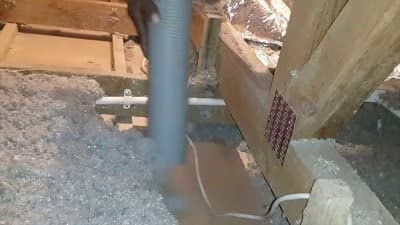
Cellulose Insulation: Cellulose Insulation is dust-like fine paper insulation. It is not very popular in South Africa because of the dust factor, and most homes have downlights. It results in endless amounts of dust entering the house. However, the main danger is cellulose insulation’s 20% chemical mix.
Cellulose Insulation is Combustible with a BB/1/2 FIRE RATING.
Installing Cellulose insulation in hospitals and schools is not allowed.