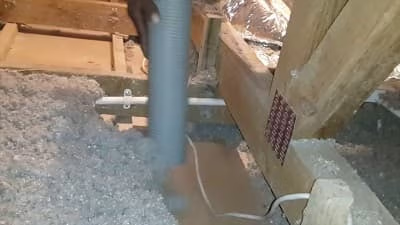
Cellulose insulation creates serious fire risks because manufacturers use recycled paper products that naturally catch fire. Chemical treatments help resist burning, but this common insulation material has hidden dangers that homeowners should know about.
Water damage creates another major issue. Many cases show how cellulose insulation soaks up water from plumbing leaks and causes mould to spread across studs and drywall. The material also comes with installation problems. Poor fitting leads to gaps that affect temperature control, and dense-packed cellulose can spread dust through your home.
Building experts now warn against cellulose insulation, backed by scientific evidence and structural issues from real-life cases. Laboratory studies and professional experience over the last several years reveal all the risks linked to this traditional insulation choice.
Scientific Evidence Against Cellulose
Lab studies show substantial concerns about how cellulose insulation performs in different conditions. Research proves that moisture levels directly affect thermal conductivity. The more moisture present, the higher the thermal conductivity, reducing how well the insulation works.
Research study findings
Scientists have found that water dosage increases density, modulus of elasticity, and thermal conductivity. The thermal performance of cellulose insulation drops substantially when it absorbs too much moisture. High humidity conditions can push moisture levels above 90% relative humidity, creating perfect conditions for mould growth.
Research from several institutions shows cellulose insulation’s ability to retain moisture can be both good and bad. The material helps control indoor humidity, but lab tests show that dried paper fibres become more muscular and less porous. This change might affect the insulation’s thermal conductivity.
Laboratory test results
Lab analysis reveals some safety issues. Scientists tested 19 samples for critical radiant flux, and all but one failed to meet the ASTM C 739 standard. The California Bureau of Home Furnishings and Thermal Insulation’s research discovered that boric acid and borax levels dropped over three years.
Scientists have found three types of water inside cellulose fibre walls:
- Nonfreezing bound water
- Freezing bound water
- Free or unbound water
Expert analysis and opinions
Building scientists worry about how this material reacts to environmental conditions. Their studies show that drying times could take longer if too much water gets in during installation. This is even more likely in humid, cold climates. Construction schedules can fall behind; worse yet, mould might grow in the material or nearby wooden structures.
Independent labs have found that cellulose insulation contains about 20% fire-retardant chemicals by weight. These chemicals, especially sulphates, can corrode pipes, wires, and fasteners under certain conditions. Oak Ridge National Laboratory confirms this risk of corrosion when metal parts stay in contact with wet, treated cellulose insulation for a long time.
Medical experts have raised more safety concerns about common fire retardants used in cellulose insulation. Research suggests that borates and boric acid could cause toxic poisoning through cuts or scrapes. The study also shows that heavily treated respirable cellulose dust can release large amounts of easily dissolved boric acid in lung tissue.
Structural Integrity Concerns
Cellulose insulation’s most significant structural problems come from how much it settles and how its weight spreads. Recent studies show modern cellulose settles between 13% and 20% after installation. This settling doesn’t stop quickly – it keeps going for weeks, months, and years after the original application.
Weight and compression issues
The weight of cellulose insulation needs careful thought. R38 insulation weighs about 1.14 pounds per square foot when installed at 12.33 inches deep. The density changes based on how you install it:
- Horizontal applications need 44.4 kg/m³ design density
- Vertical applications require at least 57 kg/m³ density
- Wet spray applications range from 39.6 to 71.3 kg/m³ depending on moisture content
Impact on building materials
Building components face real challenges when paired with this material. Most ceiling structures can handle standard insulation weights, but moisture absorption can make the load much heavier. Cellulose can soak up to 130% water by weight, which might damage ceiling integrity.
The weight of cellulose insulation can squeeze pre-existing insulation materials. This compression ends up affecting how well the building’s thermal envelope works.
Settlement problems over time
The most extensive longitudinal study reveals some worrying trends about long-term settling. Lab tests show the first settling happens through drop impact tests (10.5%) and cyclic humidity testing (11%). Field observations of 38 houses showed an average settling of 11.1% in just the first year.
Settling creates several structural issues. It guides the formation of gaps in insulation coverage. Installers must add extra material to make up for future settling. Despite that, bridging can still happen when insulation pulls away from wall cavities.
Areas with humidity that swings between 50% and 80% need higher installation densities of 62.3 kg/m³ to stop settling. How this material reacts to environmental conditions makes regional climate patterns a vital factor in deciding proper installation specs.
Environmental Impact Assessment
The environmental effects of cellulose insulation tell an interesting story with both good and bad sides that need a closer look. Let’s examine some key concerns about the manufacturing process.
Manufacturing process concerns
Building materials create about 6% of all fossil fuel emissions in the US, which adds up to 370 million metric tonnes. Cellulose insulation needs 13 times less energy to make than fibreglass. The manufacturing plants run on electricity, which helps cut down carbon emissions.
The material has up to 85% recycled paper and cardboard fibres, making it the building insulation industry’s leader in recycled content. Fire retardants make up the rest, and experts call them safe with little to no toxicity.
Disposal challenges
Waste management faces some unique hurdles with cellulose insulation. The fire retardant treatment means you can’t recycle the material. Local rules are strict about how to get rid of it safely to protect people and the environment.
Proper disposal needs:
- Review of local disposal regulations
- Use of protective gear during handling
- Secure bagging of materials
- Transport to appropriate facilities
Ecological footprint
The environmental impact goes beyond just making and throwing away the material. Cellulose insulation saves 277,000 tonnes of paper from landfills each year, which helps protect 157,000 acres of forest. A metric tonne of paper breaking down in landfills creates 1,890 kg CO2e when no one captures the greenhouse gases.
Carbon storage is a big plus for the environment. Softwood paper fibre’s weight is about 50% carbon that comes from the air. Instead of letting this carbon escape through decay or burning, cellulose insulation keeps it locked in buildings, sometimes for up to 100 years.
The US turned 513,516 tonnes of waste paper into cellulose in 2022, which stopped about 960,000 tonnes of emissions. We could do even more with the 21 million tonnes of paper waste that nobody recycles – turning it into cellulose would be a big deal as it means we could cut emissions significantly.
Climate-Specific Performance Issues
Performance tests show that cellulose insulation behaves differently under various climate conditions. Knowing these patterns is vital to install and maintain it properly.
Humidity and moisture challenges
Cellulose insulation’s hygroscopic nature creates unique moisture management challenges. Research shows cellulose can absorb and release water vapour, and its moisture buffering values reach 3.06 [g/m2 %RH]. This characteristic affects the material’s performance and structural integrity.
Lab studies prove dense-pack cellulose resists airflow better than fibreglass batts. The material also shows higher vapour permeability compared to expanded or extruded polystyrene. These properties help cellulose balance moisture levels inside wall cavities and prevent sudden relative humidity spikes.
Temperature fluctuation effects
Temperature changes affect cellulose insulation’s performance and durability significantly. Here are the critical temperature thresholds for cellulose decomposition:
- Decomposition starts at 250-260°C
- Maximum decomposition happens between 250-380°C
- Carbonaceous residue reactions begin around 450°C
The material becomes less stable above 260°C. Density plays a significant role in thermal decomposition. Lower-density materials need higher temperatures to decompose similarly.
Regional considerations
Installation requirements change based on location. Southern regions like Louisiana and Mississippi face significant challenges from humidity that affect long-term performance. The wet spray method works better in warmer climates because drying times vary.
Research from Interior Alaska shows that traditional residential wood-frame walls with cellulose insulation work well when proper vapour retarders are in place. These walls thaw and dry quickly toward the exterior during spring’s warmer temperatures.
Field studies reveal that walls without vapour retarders stay above 80% relative humidity in most winter periods. This creates perfect conditions for mould growth. Walls with proper vapour retarders rarely hit this critical threshold. Each region needs different amounts of exterior cellulose for reasonable moisture control. Fairbanks suggests at least two-thirds of the total insulation value outside the sheathing.
Cellulose insulation’s natural moisture content ranges from 8-12%. The material stays structurally sound even at 30% moisture content, which happens right after wet spray application. Under normal conditions, the insulation returns to baseline moisture levels within weeks if installed correctly with proper ventilation.
Real Estate Value Implications
Property values now reflect buyers’ importance on home safety and energy efficiency. Homes with excellent insulation sell for 2-3% higher than similar properties. A National Association of Realtors survey explains that heating and cooling efficiency tops the list of ‘green’ features homebuyers want.
Effect on home resale value
Cellulose insulation’s financial benefits go beyond the original installation costs. Every £18 spent on insulation and air sealing brings back £72 or more through energy savings and increased home value. Market analysis shows that properties with good energy efficiency ratings sell for up to 10% higher.
Real estate professionals stress how proper insulation matters when listing properties. Energy efficiency relates directly to property value because homebuyers look for properties with lower monthly utility costs. Houses with modern insulation tend to sell faster in competitive markets.
Disclosure requirements
The Federal Trade Commission requires specific disclosures from insulation sellers and installers. The R-value Rule demands detailed information about:
- Product R-value and related specifications
- Coverage area per package
- Installation guidelines and air sealing information
- Thickness requirements and compression effects
Sellers must provide fact sheets with installation details and safety considerations after installation. The Consumer Product Safety Commission makes labelling mandatory to warn installers and consumers about fire hazards linked to cellulose insulation.
Buyer concerns and objections
Buyers of both new construction and existing homes express growing concerns about cellulose insulation. Insulation problems can affect purchase decisions more than other improvements. Buyers worry most about:
Cellulose’s ability to hold up to 130% water by weight raises serious concerns among potential buyers. Home inspectors check insulation levels in attics, walls, crawl spaces, and basements to ensure proper installation within the recommended R-values for each climate zone.
Real estate agents tell sellers to fix any insulation-related problems before listing properties. Licenced home inspectors or energy auditors review insulation quality carefully and focus on installation standards and possible moisture-related issues. Houses with documented insulation problems stay on the market longer and receive lower offers, showing buyers’ awareness of long-term maintenance needs.
Industry Expert Perspectives
Professional assessments of cellulose insulation show how its benefits and drawbacks work together. Building experts from many fields have different views about this common material.
Contractor testimonials
Field professionals have mixed feedback about cellulose installations. We noted that dense-packed walls work remarkably well. The leakage drops from 0.4-4 cfm/ft² to 0.04-0.2 cfm/ft² at 0.3 in. w.c.. Quality control methods like infrared camera inspections help ensure proper cavity filling.
Experienced installers stress that managing moisture is vital. Contractors must fix any water leaks before they start the installation. Professional installers say dense-packing walls work well, but this technique can be risky in unvented cathedral ceilings and flat roofs.
Engineer assessments
Engineering analyses point out several key concerns. Research shows that cellulose insulation needs specific density requirements:
- Horizontal applications: 44.4 kg/m³
- Vertical applications: minimum 57 kg/m³
- Wet spray applications: 39.6 to 71.3 kg/m³
Technical evaluations show that borate salts, which prevent combustion, might leach out under certain conditions. Ammonium sulphate now replaces some borate content to cut costs. Engineers say these chemicals fight fire well, but their water solubility raises questions about long-term performance.
Building scientist insights
Oak Ridge National Laboratory researchers have done extensive studies on cellulose performance. Their findings show that dense-packed cellulose and fibreglass aren’t air barrier materials, though they significantly reduce air leakage. Building scientists stress that proper installation is key to getting the best results.
Research from Tennessee Technological University shows fire-retardant chemicals stay stable except at very high temperatures. Boric acid loss becomes noticeable only at 90°C with 100% relative humidity. People sometimes worry about chemical dissipation, but studies show minimal loss in normal building conditions.
Building science experts have specific installation requirements for different climate zones. The material’s hygroscopic properties mean you must consider regional humidity patterns. Scientists recommend higher installation densities of 62.3 kg/m³ in areas where humidity changes between 50% and 80% to prevent settling.
Professional assessments highlight the importance of proper installation techniques. Building scientists say cellulose insulates well, but its performance depends heavily on correct application methods and appropriate use cases. Poor installation can cause significant performance issues, especially in areas prone to moisture or spaces with inadequate ventilation.
Case Studies of Failures
Fire departments in several jurisdictions have found alarming patterns of cellulose insulation failures. The Syracuse Fire Department reported five fires with blown-in cellulose insulation in just two weeks. These incidents happened because of overheated wiring hidden in attic spaces.
Documented insulation failures
A detailed analysis of cellulose insulation performance showed 73 fire incident reports from twelve states and municipalities. The reports proved cellulose insulation helped fires spread from living areas into attic spaces. The National Bureau of Standards study raised serious concerns about long-term fire performance. 13 19 samples showed clear signs of fire-retardant chemical separation.
Technical tests revealed these concerning results:
- 10 out of 19 samples didn’t meet ASTM C 739 criterion for critical radiant flux
- Fire retardant worked much less well after just one year
- Fires kept rekindling hours after the original fire was put out
Property damage examples
A case from North Texas shows typical moisture-related failures. The owners of a 9,000-square-foot home saw extensive damage right after construction. Tests showed mould growing on interior surfaces. Water got in through two main paths: it seeped through mortar-packed masonry wall cavities and leaked through poorly installed window flashing.
Ceiling collapses have become a common problem. Reports show that water-logged cellulose insulation soaked up to 130% of the water by weight, which made structures fail. These moisture problems now show up as:
- White stains on hardwood wall panelling
- Mould behind painted wood trim
- Damaged gypsum board materials
Legal case histories
The Federal Trade Commission has cracked down on false claims in the insulation industry. Most court cases dealt with unproven R-value claims and misleading performance statements. The Griswold Insulation Co., Inc. versus Lula case tackled unsafe cellulose insulation that didn’t meet basic safety standards.
U.S. Greenfiber and Pulte Home Corp. faced a class action lawsuit about “wet blown cellulose insulation.” Homeowners claimed the Cocoon insulation caused mould growth, especially in bathrooms and near bathroom fixtures. They wanted compensation and punitive damages for thousands of affected California homeowners.
The Consumer Product Safety Commission required warning labels to alert installers and consumers about fire risks. Manufacturers now must provide precise details about:
- R-value specifications
- Coverage area calculations
- Installation guidelines
- Safety considerations
Modern Building Science Solutions
State-of-the-art building science gives us better options than traditional cellulose insulation. Modern materials are safer and work better. These improvements tackle the age-old worries about fire safety and moisture resistance.
Contemporary insulation technologies
Advanced spray foam technology leads the pack in modern insulation solutions. Closed-cell spray foam delivers an impressive R-value of 6.5 per inch, while open-cell variants give R-3.5 per inch. Closed-cell foam’s higher density of 2 pounds per cubic foot creates a solid air and vapour barrier.
Rigid foam boards are another breakthrough in insulation technology. These panels give twice the thermal resistance of traditional materials. They work great for whole-house insulation. Extruded polystyrene and polyisocyanurate boards resist moisture exceptionally well and stay structurally stable.
Mineral wool contains about 75% post-industrial recycled content and resists fire naturally without added chemicals. It keeps performing consistently no matter what the environment throws at it.
Performance comparisons
Modern insulation materials show clear advantages in thermal performance:
- Closed-cell spray foam: R-6.5 per inch
- Polyisocyanurate: R-5.5 to R-6.5 per inch
- Mineral wool: R-3.5 to R-4.5 per inch
- Fibreglass: R-2.2 to R-4.3 per inch
Spray foam insulation creates an airtight seal that cuts air infiltration up to 24 times compared to traditional materials. The material stays stable and won’t settle, so it works just as well throughout life.
Polyisocyanurate boards usually come with foil facings and resist thermal drift exceptionally well. These boards keep their insulating properties better over time than materials that might settle or get compressed.
Installation advantages
Modern insulation technologies come with clear installation perks. Spray foam needs professional installation because of special equipment and safety needs. This might seem to limit initially, but it will give a perfect application and the best results.
Rigid foam boards are straightforward to install for both pros and skilled DIYers. Their uniform structure makes precise cutting and fitting easy, which means fewer gaps and thermal bridges.
Liquid foam installations need professional certification to guarantee proper thickness and coverage. These installations must have an approved thermal barrier that matches a half-inch gypsum board in fire resistance.
Modern materials solve several key issues during installation:
- Moisture management through vapour barriers
- Proper ventilation requirements
- Thermal bridging prevention
- Air sealing effectiveness
Building codes now recognise how necessary proper installation is. Professional installers must document:
- R-value specifications
- Coverage calculations
- Installation procedures
- Safety considerations
Modern building science shows why whole-system design matters. Insulation materials and other building parts need to work together. This means looking at:
- Climate zone requirements
- Moisture management strategies
- Ventilation systems
- Air barrier continuity
These new solutions handle traditional insulation challenges better than ever. Better materials and installation techniques give us more reliable and efficient options for new construction and updates.
Conclusion
Research and real-life cases show the most critical risks of cellulose insulation. Fire safety remains a primary concern because the material catches fire quickly and chemicals can leak out. The material’s moisture problems threaten building strength and people’s health through mould and decay.
Of course, cellulose insulation helps the environment by using recycled materials, but problems with long-term use and disposal outweigh these benefits. The material settles over time, distributes weight poorly, and doesn’t work well in certain climates. These issues limit its use in today’s construction projects.
Building science now offers better options to fix these problems. Spray foam technologies and rigid foam boards work better at keeping heat in, stopping moisture, and staying stable. When appropriately installed, these new materials give safer and more reliable results for both new buildings and updated projects.
Builders and homeowners should consider these proven risks carefully before choosing insulation materials. Evidence shows that newer insulation technologies are better investments for safety, efficiency, and property value in the long run.